
The Diplomatic Diary Interview: Build Trust Before You Need It – H.E. Matilda Aku Alomatu Osei-Agyeman

Speaker Bagbin hails Ambassador Alomatu Osei-Agyeman over UN finance resolution
July 16, 2026
Notice: CAP 30 Pensioners & Beneficiaries Verification Exercise in Vienna
August 4, 2026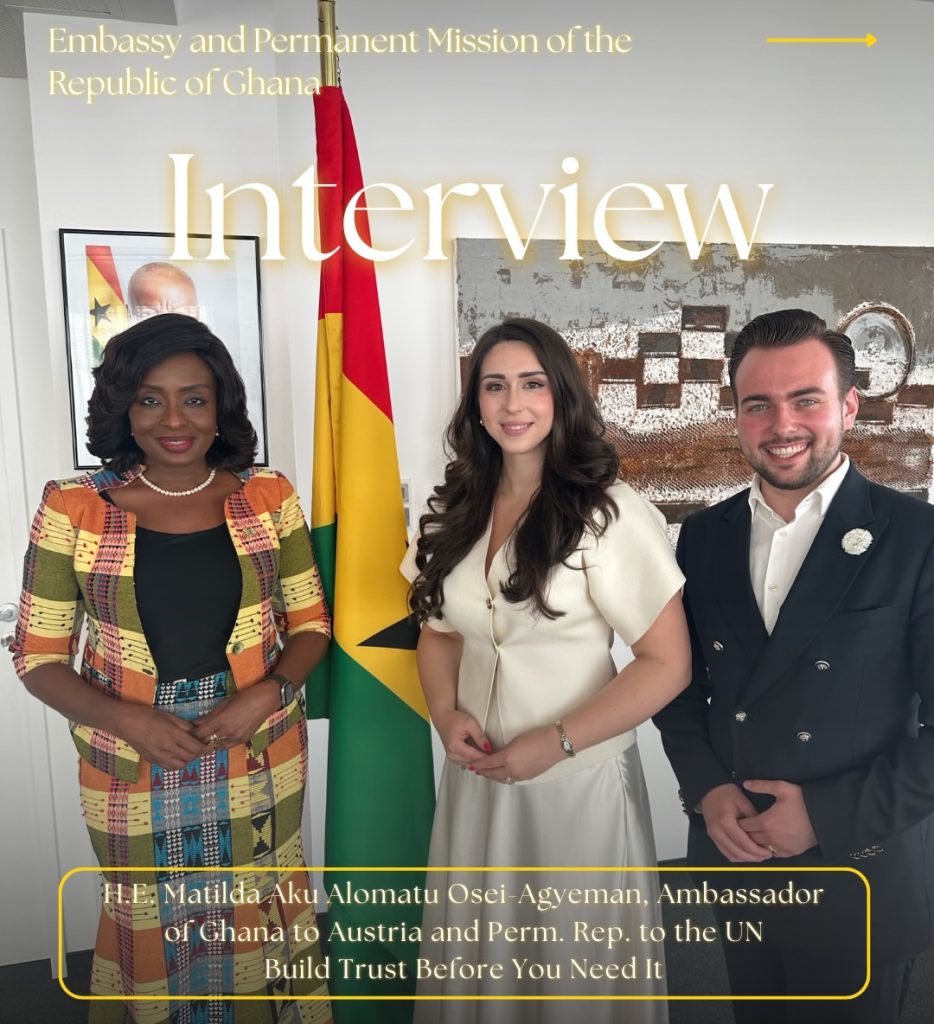
An interview with H.E. Matilda Aku Alomatu Osei-Agyeman, Ambassador Extraordinary and Plenipotentiary of the Republic of Ghana to the Republic of Austria and Permanent Representative to the UN.
“You have to walk into the room feeling that you belong.”
She is easy to find at a Vienna reception. In a room of dark suits and winter greys, the Ambassador of Ghana arrives in a kaba and slit of African print and at times handwoven kente, and people come over. They ask where the cloth is from. By the time she has answered, a conversation has started, and something has been exchanged that no formal meeting would have produced.
Two decades ago, the same woman flew into this city as a junior officer, covering its meetings from the back of the room for three or four days at a time before flying back to Geneva where, at the time, Ghana covered Vienna from. She has now returned as the ambassador in charge. It is a fitting arc for someone whose whole method rests on a single, unhurried idea: build trust before you need it.
H.E. Matilda Aku Alomatu Osei-Agyeman has spent twenty-seven years in the service of Ghana, and worked across postings in Geneva, Washington DC, Valletta, London, Rome and now Vienna. She has thought carefully about how a country that is not the largest, the richest or the most heavily armed makes itself heard.
A Vocation, Not a Profession
She did not grow up wanting to be a diplomat. She wanted to be an environmental lawyer, which she notes would have suited this moment rather well. Instead she kept drifting, almost without noticing, into the work of diplomacy: sitting with women from around the world, comparing countries and cultures and governments, and doing charity work beyond Ghana’s borders, including a project on street children alongside a former First Lady of Cote d’Ivoire.
“At the time I did not even realise it was leading me towards diplomacy,” she says. “I was just doing it.”
The choice came in stages. A first degree in Political Science from the University of Ghana. A near detour into the private sector at her father’s suggestion. Then, in 1999, the decision to commit. She describes it as two things at once, a deliberate choice and a natural unfolding that dovetailed into each other.
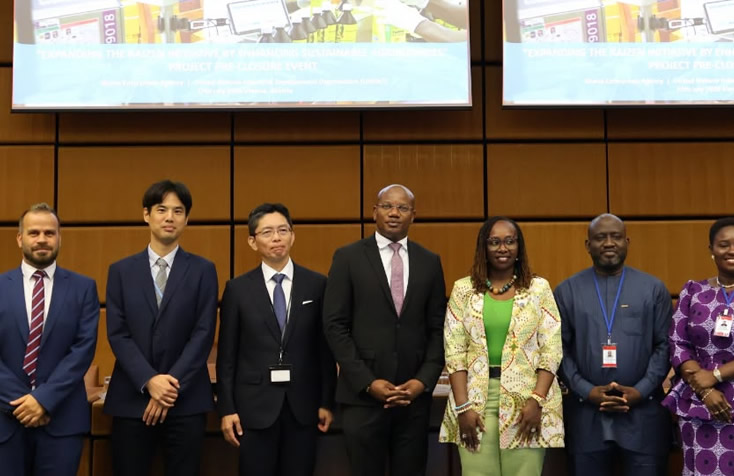
What she is clear about is what the work became. “It became a vocation for me, not only a profession.” Diplomacy, in her account, is less a set of procedures than a way of relating to people. Understand them before you speak. Listen before you speak. Find the common strand that runs through people’s differences, because very different positions often still contain something everyone can accept. This proved useful when she chaired the Board of Governors of the International Atomic Energy Agency (IAEA).
What Diplomacy Asks of a Smaller Power
Ask her what diplomacy means in the current order, and she seizes on the phrase. “Everything happening on the geopolitical scene demands experience in diplomacy,” she says. Bilaterally the work is manageable. The turbulence is multilateral, and that is where a country like Ghana is tested.
Her toolkit is coalitions and consensus. Knowing when to stand with the Group of 77 (G77) and China, when to move with the African Group, when to work with the larger powers. Treating collaboration between the global north and south as essential rather than optional. And arriving with a record, because trust follows reputation.
She is candid about where that trust is built. Not in the conference room. “You build them over tea, over coffee, in informal settings, so that people warm up to you. When you later want to push a resolution, the relationship you formed on a friendly footing can win you a great deal of support.”
Beneath it sits a conviction she thinks a diplomat has to declare openly today: belief in the rules-based international order. Multilateralism is under criticism, she acknowledges, and changes are needed. But those who believe in it have to speak with one voice and win over the doubters rather than surrender the system to them.
A Mandate, Not a Victory
In 2021 Ghana was elected to the United Nations Security Council with 185 votes out of 193, the highest count in that round and the country’s fourth term. Alomatu Osei-Agyeman ran the candidature, coordinating across the roughly sixty Diplomatic missions of Ghana, the Permanent Mission in New York, ministries in Accra and the Presidency itself. The lesson she draws is not only about logistics.
“Trust is built slowly,” she says. “People gravitate towards you based on what you bring to the table.” Ghana brought its record: among the top ten troop contributors to the United Nations, long service in the United Nations Interim Force in Lebanon (UNIFIL), sustained work on the women, peace and security agenda. When the votes came in, the feeling was not triumph. “It felt less like winning and more like a responsibility being placed on us, and being given back to those who had placed it on us”
She offers one warning to anyone who will one day run a campaign of their own. A promise is not a vote. People will tell you they support you, and you must still work to the last day to secure the ballot of two-thirds majority. Sit back because you feel confident, and you will lose the votes you assumed you had.
Women, and the Route Up
She has invoked women, peace and security more than once, so we asked her what it is like to be a woman at the top of this profession. Her answer is structural. The path has to be open, from entry level through the middle ranks and up, held open by conscious effort rather than goodwill. When she joined, women were the minority. In recent years she has watched women become the majority in Ghana’s foreign service, and yet the higher ranks stayed male.
She is careful about the remedy. “It is not a favour. It is recognising our merit and balancing the scales so we can reach the higher ranks.”
She names the pattern plainly. When a shortlist reaches the top and the candidates perform alike, someone may still say they would rather take the man. That is what has to be debunked, and the way to debunk it is to arrive, do the job, and compete on merit until there is no argument left to make. And there is a duty that comes with having climbed. Mentorship runs both ways: the senior woman makes herself available, the younger one is willing to be a mentee. As she rises, she considers it her job to bring others up with her.
Her hope, characteristically, is to make the conversation unnecessary. “The more we talk about it, the bigger we may make the problem seem.”
The Skills That Are Not on the CV
The degree, she says, is the price of entry. What distinguishes people afterwards is everything the transcript does not capture.
Commitment first. She has seen colleagues join the service and leave, disappointed that it was not what they had imagined. Then the soft skills, which she does not treat as soft at all. Negotiation. The emotional intelligence to read a room and sense, from a shift in body language, that someone will not support your resolution, so you can approach them differently. Wide reading, and not only in diplomacy: history above all, because what is happening now has usually happened before, and the question is whether you are learning from it.
Above everything, listening, especially to people you disagree with. “The more you listen, the better you understand how to manage the issues.”
She passes on advice she was given years ago by a senior diplomat, now retired and an adviser to Ghana’s Foreign Minister and the President. “Matilda, make sure you are very well put together.” Read about etiquette even if no one trains you in it. Mind how you speak and present yourself. People-to-people management, she insists, is the substance of the work, not a nicety. And be magnanimous. Not extravagant, but generous enough to say, I wanted that seat, but I will give it to you. Approachable rather than stiff, because coalitions are built by people, and people are drawn to those they can reach.
A Matter of Dignity
Her clothing does real work in a room, and she knows it. She dresses, by her own reckoning, about ninety percent Ghanaian to ten percent European: the kaba and slit, the tailored two-piece worn by women across Ghana, cut from handwoven kente or wax print. It is a choice she describes as a matter of dignity. She will not put her own culture at the periphery, and she does not treat it as decoration.
“When you walk into a room in African print, people gravitate towards you. They want to know where it is from, and while you explain, you have already broken the ice.”
The questions follow. Where are you from? What do you export? The answers she gives are less a pitch than a correction to how little the room tends to know: Ghana is one of the world’s leading cocoa producers, second in Africa only to Cote d’Ivoire; the continent’s largest gold producer; host to the secretariat of the African Continental Free Trade Area (AfCFTA), a market of some 1.3 billion people. A remark about a fabric ends somewhere near trade and investment.
But she is firm about its limits. “I would rather people did not concentrate only on how I look. I would rather they concentrate on what I bring to the table.” What she wears draws people in; what she says holds them. She wants both working together, which means walking in prepared and well read, so the words match the impression. Her dress is not a costume. It is an invitation she then has to earn.
Vienna, Twice
There is a symmetry to her posting that she clearly savours. Ghana had no embassy in Vienna when she first worked on it, so she covered the city from Switzerland, a junior officer and first Secretary flying in for a handful of days at a time, sitting at the back of meetings and, as she puts it, becoming a student of the environment. “Vienna gave me an education.”
Now she signs off on sensitive matters that shape Ghana’s relationships with Austria and with the organisations based here, among them the International Atomic Energy Agency (IAEA) and the United Nations Industrial Development Organization (UNIDO), United Nations Office on Drugs and Crime (UNODC), United Nations Commission on International Trade Law (UNCITRAL), United Nations Office on Outer Space Affairs (UNOOSA), Comprehensive Nuclear-Test-Ban Treaty Organisation (CTBTO), among others. What she says can affect more than thirty million people at home. The city that taught her, has given her the chance to give the knowledge back, a first posting that became, years later, the high point of a career.
A Sense of Home
Ask her where home is, and the answer is not simple. Structurally, it is Ghana. But a diplomat carries every city with her, and holds bits and pieces of each one inside. “The people I have met become part of my family.” Home, in her telling, is less a place she has arrived at than everything she has gathered along the way and put together.
What She Is Reading
The book is Kofi Annan’s memoir, Interventions: A Life in War and Peace. She reaches for it as a fellow Ghanaian, and for its honesty about the good and the bad, which she thinks many diplomacy books avoid. It speaks about the loneliness of leadership, about deciding without all the information in front of you, about carrying small successes you cannot share. It does not flinch from Rwanda, the episode the world held against him, when, she recalls, he telephoned around a hundred heads of state with little or no help. He would later receive the Nobel Peace Prize for his humanitarian work. That contrast, vast achievement beside the few things that could have gone otherwise, is one she says every leader eventually recognises.
Beyond the memoir, her prescription is her method: read ordinary history, and listen to people you disagree with. Listen to your opponents, she says, and you will learn how to handle them.
What We Took Away
The lesson she keeps returning to is not about eloquence or nerve. It is patience. Trust, in her telling, is built slowly and long before it is needed, over coffee rather than across a negotiating table, through a record compiled over years rather than a case made in a single meeting. It is not the most exciting thing to tell someone starting out, but it may be the truest, and it carries a quiet instruction inside it. The relationships that will matter to your career are the ones you begin now, before you can see what they are for.
We thank H.E. Matilda Aku Alomatu Osei-Agyeman for her time and her candour.
Original Article: https://thediplomaticdiary.substack.com/p/build-trust-before-you-need-it-he
 English
 Deutsch